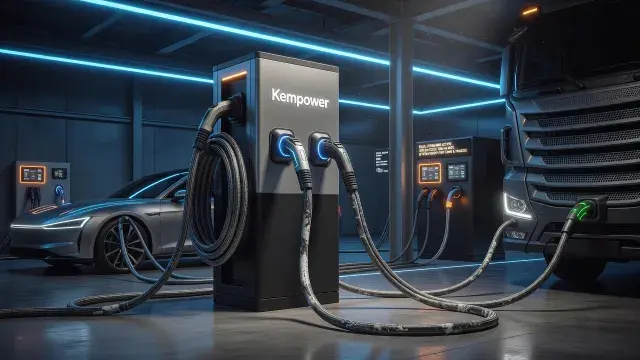
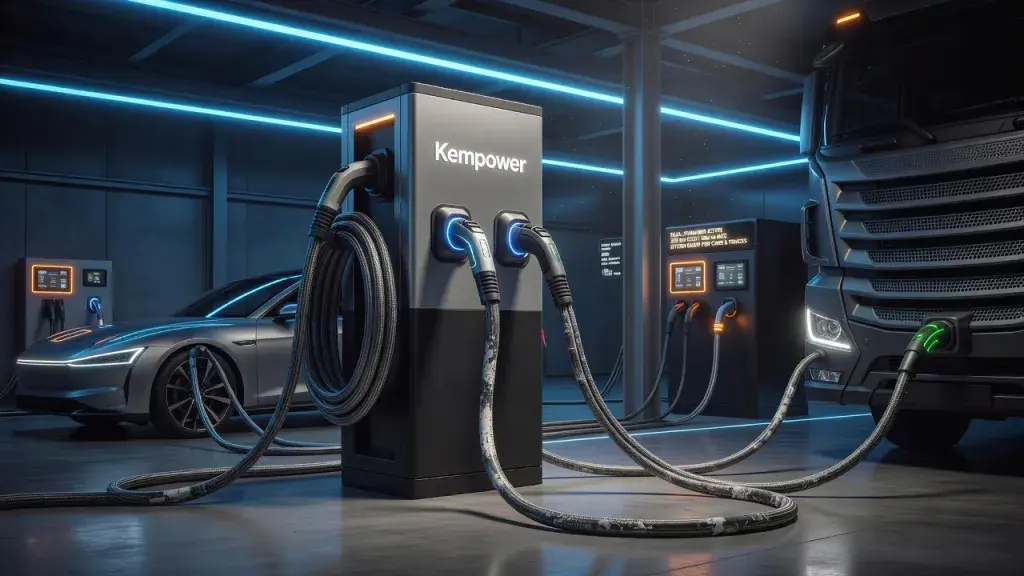
Kempower has introduced a single charging unit capable of delivering power to both passenger EVs and heavy-duty electric trucks, a move that addresses one of the thorniest problems facing charging network operators today: how to serve two very different vehicle classes without building two separate systems. The new device, called the Mega Satellite Flex, supports the established CCS standard at up to 560 kW and the emerging Megawatt Charging System at up to 1.2 MW, making it the company's first dispenser to bridge both protocols in one piece of hardware.
The timing reflects where the electric vehicle industry actually stands, rather than where marketing decks sometimes suggest it stands. CCS remains the dominant charging standard for cars and light-duty vehicles across North America and Europe, while MCS is still in its early rollout phase, designed specifically for the enormous power demands of electric semi-trucks and other heavy freight vehicles. Anyone evaluating charging infrastructure claims would do well to learn how to spot a marketing claim that means nothing, because "high-power" and "future-ready" get used loosely in this sector, and the real test is whether a unit can actually serve both current and next-generation vehicles without a second construction phase down the line.
Why One Machine Instead of Two
Building separate charging infrastructure for cars and trucks has been the default approach for most operators, largely because the two vehicle types have historically required different plug standards, different power delivery systems, and different site layouts. That approach works, but it doubles the capital outlay and often means digging up pavement a second time when truck charging demand eventually catches up to passenger EV demand. Kempower's pitch is that a site built around the Mega Satellite Flex can serve both populations from the outset, deferring or eliminating that second buildout entirely.
The unit also supports 800-volt vehicle architectures, an increasingly common feature in newer EVs designed to charge faster by reducing current for a given power level. That compatibility matters because it lets a single charging site accommodate a wider mix of vehicles at higher speeds, which in turn improves how often each charging bay gets used across a typical day. Utilization is the metric that ultimately determines whether a charging site turns a profit, and idle equipment is the biggest drag on that calculation.
Technical Specifications and Integration
The Mega Satellite Flex is built to handle substantial current on both sides of the standard: up to 1,500 amps for MCS and 700 amps for CCS. Cable lengths differ by standard as well, with 5 meters (16.4 feet) for CCS connections and 2.7 meters (8.86 feet) for MCS, a shorter reach that reflects the heavier gauge cabling megawatt charging requires. An optional payment terminal can be built into the unit, a detail that matters for public charging sites where card payment remains the norm for occasional users.
Kempower says the new dispenser works within its existing distributed charging architecture, meaning operators who already run Kempower systems don't need to replace or redesign their power cabinets to add megawatt-capable charging. That backward compatibility is arguably as significant as the raw power figures, since infrastructure investments only pay off if they can be upgraded incrementally rather than torn out.
What Comes Next
Kempower revealed the Mega Satellite Flex at its Unplug & Recharge event held alongside ACT Expo, a gathering focused on advanced clean transportation technology. The company says the charger will go on sale in North America and Europe in July 2026, giving fleet operators and charging network developers over a year to factor the technology into site planning. Whether MCS adoption accelerates quickly enough to justify dual-standard sites broadly, or remains concentrated around freight corridors and logistics hubs, will shape how much of the industry follows Kempower's lead.